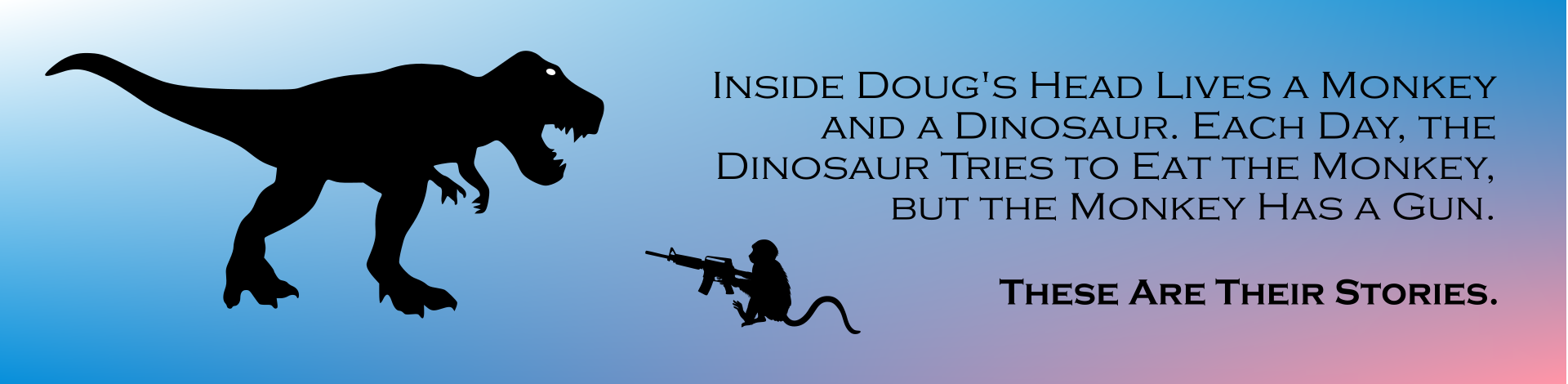
Inside Doug's Head

It is never too late to become wise.

Hold on there, you with 911 on speed dial, I’m just being dramatic, not confessing to a major crime. My eighth-grade year was an eventful one, for it was that same year that I poisoned my English teacher.

It was a dark, dreary, overcast morning and, for English class that day, we were going to be watching a film reel on an old play written by some Shakespeare guy. My teacher (technically, he wasn’t really mine because I think he belonged to the school board since they had acquired him as an orphan in the 1930s) would waltz into our classroom (again, it wasn’t really ours, as the District owned the school and we just visited the place on the weekdays, but this is going to be a long story if you keep making me clarify these little points) every morning with his cup of coffee in hand, however this one day he realized he had forgotten something after getting to class. Upon leaving to retrieve that which he was missing, he left his cup full of coffee unattended on the big desk at the front of the room. Sadly for him, it was within reaching distance of me, and that was a big mistake. Correction, two big mistakes. Well, possibly, one big mistake and one lesser mistake with the potential for significant repercussions.

Now, either coincidentally or by a twist of fate, a nearby classmate of mine had recently started using a fountain pen for writing his school work. Not one of the fruity fountain pens made out of a huge gay feather from an endangered species of smelly bird, but one with the fat ink cartridge on the inside. Seizing the opportunity for unobserved mischief, I snatched the pen from his hand, held it over the steaming cup of coffee, and gave it a short, abrupt, downward stab into the air.

Ever do something evil and then realize that it worked better than you wanted it to? Well, oh my, this stream of ink came squirting out of the nib of the pen and only partially hit the coffee surface. The bulk of it landed on the inside, outside, rim, and handle of the cup, and it splashed all over the desk, the desk pad, and every single sheet of paper in between.  You know that hollow, yawing, tingling feeling you get in the pit of your stomach when reality yanks your chain and you prepare yourself for the hurt you know will soon follow? Me, too. Right then, I felt all of that and a whole lot more.

You see, the English teacher wasn’t one of those frilly little poetry-reading turds living in constant peril of being carried away by a strong breeze. No, this guy was pretty rugged, and he carried himself with the stature and disposition of a prison guard. He was also the vice principle of the school, and there were rumors he had previously killed a student over a troubling matter of a late assignment. I knew I would be next, exactly one second after he returned and discovered the layer of inky goo all over his cup and desk. In a panic driven by terror, I grabbed a wad of paper towel from a nearby roll and started quickly cleaning up.

The lights were off in the room, in preparation to watch the film thingy, and it was difficult to see exactly where all the dark blue splatter had settled. Ink doesn’t come out of paper and wood very well by frantically rubbing it with more paper. Then there was the cup. My initial instinct was to toss it out the window and pretend like he had forgotten to bring it to class. I quickly practiced my best, What cup? look and found it somewhat less than convincing. So, I engaged Plan B: flip the pen over, stick it in the coffee and stir with great vigor. One, two, three stirs in, and I hear, “What the hell are you doing to my coffee?” in a loud booming voice emanating from a silhouetted figure in the doorway.

Busted. There was no way to make it look like anything innocent, accidental, or even remotely understandable. Without attempting to respond, I immediately backed away like a cat with wet feet standing on a hot electric griddle. The lights were off in the room and the teacher couldn’t really see me all that well, not from the door and not with the contrast of the light in the hallway. I coolly sat down in my chair and said nothing. He marched brusquely to the front of the room, lifted and examined his cup, and momentarily sent me a scowling suspicious look that punched a hole through the darkness. After a heart stopping few seconds, he dropped the sinister stare and we proceeded to watch the film.  He sat off to the side of the room, quietly drinking his cup of ‘coffee.’

At the end of the class, the lights came back on. The teacher stood and said a few words about the nature of the timeless genius of Shakespeare, and returned his presently empty cup to the desk. Now, for sure, I was fully expecting he was going to die soon from ink poisoning. Maybe that’s the part that makes it a felony—the expectation of someone dying as a result of something you have done. Or, perhaps it is the watching in silence and doing nothing to warn your potential victim. Either way, the lights came back on and the ink that was clearly everywhere became so much more visible. I knew he saw it and recognized it for what it was, for he was neither blind nor stupid. In addition to the broad scatter pattern across the wooden desk surface, the ink was all over the inside bottom and outside of his cup, smeared upon his lips and tongue, and when he spoke I could even see it on his front teeth. All I could do was wonder if he would die before or after he killed me.

Much to my surprise and relief, he never said a word to me about the incident. At the end of the class, he just picked everything up (not, like, the whole room everything, just the stuff that he came in with—don’t be stupid) and walked out. Then I felt really, really horrible. On the inside. The ink had somehow stained my soul and I experienced a confluence of guilt and shame very deeply; but, then it went away.

Of course, I realize now the ink was non-toxic and he was never in any real danger of dying from it. I imagine he’s dead now, though, because it has been nearly 30 years since that day and he wasn’t a young man back then. Still, I never tried to poison anyone after that. I had learned my lesson: Even though it may seem like it would be a laugh and a lark to poison someone, it really isn’t a nice thing to do. It might just make them angry.

I had several friends growing up, in retrospect I realize so many of them were total jackasses, but one in particular stands out. He was always going on about how his father was the manager of the local Sears department store, as if that entitled him to the privileges of social royalty. They didn’t have a name for people like that back then, but in these more modern times, we call them douchebags. His younger brother was a big-fat-boy—I imagine they’re both either 800 pounds or dead, by now—who would shove people to the ground, sit on them, and fart grotesquely in their faces. By the age of nine, my friend had figured out how to do multiplication by repetitively counting his fingers and toes, so that made him some sort of math genius in the eyes of his teachers. I always felt put down and somehow inferior when I was around him, and these feelings formed the basis of our imbalanced friendship. He moved away at the end of grade six, and I didn’t miss him much, so we never kept in touch.

You know how in the movies and TV shows the dorky little kid gets viciously picked on by the bigger kids? They mercilessly do cruel things to him, make him do their homework and menial chores, and then he spends the rest of his time trying to figure out an elaborate way of getting back at them. Well, that was never me. I realized pretty quickly that evolution provides two paths for survival in the wild—either be big, or be smart. The big people were surviving the only way they knew how, and I was fully prepared to take advantage of them for that. I didn’t wait for any bullying to happen, I established trade relations right up front. I’d do the big-guy’s homework as long as he’d punch that guy over there in the groin for me, should it ever become necessary. It was win-win, except for the guy curled up in a ball on the ground holding his groin and writhing in agony. Had humans and dinosaurs traveled together on the evolutionary trail, saddle-up, I would have been the one riding the T-Rex. Thanks to my penchant for the symbiotic relationship, I was never picked on, at least not for very long.

When I was in the eighth-grade, I went a bit too far with this strategy, though. There was this guy, he must have been in his early twenties, who was assigned to our class mid-year after being released from prison. The other kids in the class started crying and pooping their pants the instant this danger-to-society walked into the room. He was huge and hard looking, with threatening tattoos, jagged scars, and arms as thick as a fat chick’s thigh. He took a seat in front of me. Boldly and without fear, I politely introduced myself, asked him if he needed anything, and offered to help him get caught up in the Math assignment during the lunch break. In spite of all his outward appearances, he was actually a pretty decent guy with a crass sense of humor, and we got along quite well.

Then, one ordinary day, a dipshit who was sitting in the desk behind me decided to start mouthing-off to me in class, making rude comments, questioning my mother’s marital fidelity, and kicking the back of my chair. Just the regular annoying thirteen year-old kind of stuff. I was fully prepared to ignore him until he got bored and moved on to someone else. My new friend had other ideas. Without warning or provocation to do so, he calmly stood up, walked over and hit the guy squarely in the center of the forehead with his fist so hard I could hear brain rattling around skull. Thwunk! Coup contrecoup, and back again. The vulgar sound it made still haunts me to this day.

My former annoyer, now turned victim, immediately melted to the floor, completely unconscious; he even wet himself a little. That was bad enough, but my ‘friend’ then proceeded to try stuffing the limp body out through an open window, like an unwanted rag doll, or a dead hooker in your hotel room when there’s been a knock on the door. The police eventually came and dragged him away. When we first met, I should have thought to ask him why he had been in jail, because it must have had something to do with a frothy mix of rage and anger issues.

I never saw my would-be protector again after that incident. I feel somehow responsible for his re-incarceration, and the presumed forced acts of sodomy we so often hear about occurring in those places. Truly I had learned a big lesson: With great power comes a great power bill.

Like so many other people, I was born to parents. I was the last in an array of four others. Had the pill been invented much later, I would have had younger siblings; any earlier and I wouldn’t be here at all. Go figure. The bony finger of Fate was jabbing me in the ribs right from the very start. I really hate that guy.

My earliest, most vivid, childhood memory is from when I was just under two years old. I remember waking up in the middle of the night feeling bored and lonely. Besides, my bottle was empty and I needed some attention. I stood at the end of the crib I was housed in when I wasn’t watching Sesame Street and started hollering like I was on fire or being eaten by something. After several minutes, my mother came in and picked me up. Although her warm embrace made me feel better, had I actually been being eaten, the creature doing the eating would have successfully gotten away with it. I slept soundly the rest of the night with my mother and father. The next morning, I peed their bed for them as a reward for taking care of me. Sure, they complained, but I knew they appreciated it.

When I was five I jammed my thumb in the sprocket of a bicycle chain. A friend of mine and I had the bike (that’s what we used to call the two-wheeled contraptions back then) on training wheels wedged between a hollow spot in the soft ground so that we could crank the peddles and spin the wheel. For whatever reason, I wanted to get my friend to stop peddling, so I grabbed the chain with my fragile bare hand—it seemed like a good idea at the time. My hand was pulled into the business part of the mechanism and a pointy tooth on the sprocket first crushed, and then entirely removed, the nail from my thumb. It could have actually removed my thumb, but I guess it decided it had no use for the digit. There was lots of blood, and oh so much screaming. I remember wondering where all the noise was coming from, and then having it dawn on me that I was the source of the commotion. My friend ran away, the dick, and I made for the front door of my house. My thumb and I eventually recovered, but I now have a deeply rooted fear of sticking my hand in moving dangerous spinning things. Surprisingly, it hasn’t held me back any.

Later that summer, after the training wheels had been removed, I drove the same bicycle into the back of a neighbor’s car while it (the car, not the bike) was parked on the side of the road. I face-planted on the street and a few hard things in between. My face still carries the broken nose. Coincidently, it was this very neighbor’s driveway that was the scene of a previous incident involving me, my peddle car, a short but steep hill, and an abrupt halt at the end. I very nearly didn’t make it through my preschool years.

School started for me when I was six, having managed to survive that long in spite of my best efforts to contravene. Being the last in a line (well, maybe not so much of a line as a cluster) of children, I didn’t get much attention paid to me in the earlier years. I suppose this was how I managed to repeatedly throw myself in harm’s way without much adult supervision. Anyhow, I had spent the first six years and two weeks of my life alone in front of the television. I think I was four before I realized that Ernie and Bert weren’t part of my family, and I never once questioned their living arrangement.

The day before school started, my mother suddenly realized that I didn’t even know how to hold a pencil, let alone how to make it work. I remember this so very clearly, as she had become utterly frantic and distraught that I couldn’t draw a stick man, like there was going to be some sort of an entrance exam where the pivotal question would be to draw a stick man and label the critical pieces. It was probably that she realized how retarded I’d seem and she didn’t want to be the mother of the only retarded child in the class. It took all morning of concentrated practice, but I think I’ve finally got it figured out now:

A stick man with hands and feet

In hindsight, learning the alphabet would have been a better use of that time. A few of the numbers, too, perhaps. Sesame Street covers these topics, but not in any particular order. I knew of the number 7 and the letter J, but not where they placed in the grander scheme of things.

One morning of school was all it took for me to reach the conclusion that I didn’t need any more of that kind of nonsense. I came home at lunchtime and announced that I was all done with it and wouldn’t be returning. Apparently, it was never my decision to make.

There’s nothing funny about watching helplessly as your father falls off the roof of your childhood home. Or, is there?

When I was maybe six or seven years old, I borrowed-without-asking (which is technically stealing) my father’s hammer to build a tree fort in the woods behind our house. I wasn’t always careful about where I put the hammer when I wasn’t using it, so of course I eventually lost it. My father was not an angry person, but I knew that I was in for the lengthy soap-box style of preaching tirade, “Everyone always takes my things and loses them. Why don’t you lose your own things?” Curiously, this now happens to be the exact same speech I frequently give my kids. Turn-turn-turn. Back to the story.

Hoping to avoid getting in trouble, I secretly acquired a replacement hammer the next day, which I bought at the nearby thrift store for the grand sum of $3. It wasn’t an exact replacement, and I’m sure the one I lost cost a lot more, but it was just a hammer—a weight on the end of a hollow metal tube—why would I have to get an expensive one? I snuck the changeling hammer into my father’s toolbox and held crossed-fingers that there wouldn’t be dire consequences for what I had done.

One warm, sunny day of the following week, I was watching my father working up on the roof of our house using his new hammer. For me, it was a proud and somewhat satisfying moment, for although I knew that he knew it wasn’t the same hammer, I felt my father appreciated the responsibility I had shown by my mature action of replacing that which I had lost, for he never said a word about it.

While I was thoughtfully reflecting on my own brilliance, he was trying to remove a stubborn nail from an errant shingle. As he pulled hard, the handle on the hammer first bent, and then abruptly broke, while a combination of Newton’s 3rd law and gravity did the rest. My father perilously recoiled towards the edge of the roof.

Acrobatic and graceful are words that could never be used to describe my father. He stumbled forward, flailing and flapping his arms as he clumsily tried to regain his balance. After several seconds of suspense, and with his face clearly expressing his realization and fear of the inevitable, Dad fell to the ground. He landed with a heavy thump and a moan of agony in my mother’s flower garden two stories directly beneath the point where he once stood only moments earlier. I laughed, because my dad made a funny face.

I learned a lot that day about the hidden costs of inexpensive things. Mostly, though, I think the most valuable lesson to be gained from this story is that in these tumultuous economic times, it just isn’t possible for one to buy so much entertainment for only $3.

Peter Lindfield, president and CEO of the Carlisle Institute, said the biggest challenge facing the information and communication technology industry is access to cash. To me, this statement is equivalent to saying that the biggest challenge facing lazy people is access to motivation.

The information and communication technology (ICT) industry is the result of once monopolized and now deregulated telephone companies offering information-based services over their existing, and outdated, communication networks. The information services are provided through a combination of acquisitions, mergers, or corporate partnerships. Just like slathering a pig in lipstick and marrying it off to a donkey, the unholy union produces an offspring that is essentially an even fatter, uglier, and ultimately more stupid donkey. But, boy, barbecued I bet it tastes some-good.

For now, let’s just overlook the obviously retarded part that every industry has to deal with issues relating to access to capital. Even the banks, where I’m told that people who have money tend to keep it, need to find ways of financing their operations since government bail-outs only cover corruption related expenses. The core reasons ICT projects have special cash limitations are pretty simple.

1) ICT projects are expensive and often hard to justify. Unlike investments in physical assets, like a printing press or a new shotgun, which can be rationalized through present value analysis of the resulting new or improved revenue streams, ICT projects have to be qualified based on softer, more abstract, considerations. A new web-fed multicolor press will reproduce pornographic material at half our current costs, or a new shotgun will make it simpler for me to shoot you in the face are pieces-of-cake to cost justify. However, it is impossible to put a firm dollar value on formatting for the reports of peoples’ private emails will look much nicer.

2) ICT projects are notorious for being late, over budget, and frequently failing to produce their anticipated benefits. The reasons are many, varied, and complicated, but most of them are directly tied to the next item.

3) Just like in IT, ICT people are typically unqualified for the work they do. Most of them fell into the industry because they heard they were hiring, but they lack a suitable educational background to be really good at managing and coping with the complexities of the projects they have to deal with. They feel they know something about computers because they used one at work once, and they installed a wireless network device at home, so now they are communications experts. Also, they’re really weird and obnoxious, and not in a good way. You know the types. They can’t answer your question about why you can’t get connected to the network from home through the corporate VPN, so they mutter something about reimaging and awkwardly skulk away from you, hoping you won’t follow-up on the issue any time soon. Yeah, sure, I want to blindly give them millions of dollars because I know the work they do is really worth it.

Now, to be clear, I’m not picking on all the geeks and nerds out there, just the ones working in IT. These are people who, while they often don’t totally understand it themselves, feel their work is really technical and highly sophisticated. Plugging a network cable into a switch or a PC, or configuring software by selecting all the default options should not be viewed as either challenging or technical. Maybe if they stopped acting so smug all the time, people would stop throwing crap at them in the cafeteria. We know what you do and we aren’t impressed. The only reason anyone is even slightly nice to you is because you have the administrator passwords to all the servers on the network. If you disagree with these statements, disconnect the power from your computer, wait ten minutes, and then try reading this again.

4) ICT projects, due to the very nature of the technologies they implement, are obsolete the moment they are put into production. It took us three years, and we are six months behind schedule, but the version 2.0 upgrade work is finally completed. Now, let’s get started on implementing version 3.0, so we will only be two releases behind everyone else.

So, to summarize: ICT projects are difficult to explain, expensive, usually late, don’t work as expected, outdated when released, and are either implemented or supported by people who the rest of us would prefer didn’t exist. So, seriously, the ICT industry faces the challenge of access to cash is a news-worthy revelation? Putting all of your money in South American pesos would seem to be a much safer investment.

Next, I’ll try to make sense of the Carlisle Institute’s stated mission, “to democratize knowledge.”