I recently spent more time trying to locate a washing machine maintenance function than it would have taken to actually run the maintenance procedure.
That sentence sounds ridiculous, but it is true.
The machine in question is a Samsung washer and dryer combination unit with a large touchscreen, Wi-Fi connectivity, firmware updates, automatic detergent dispensing, and enough computing power to rival desktop computers from my younger years. The task should have been simple. I wanted to flush the automatic detergent dispenser with warm water, a maintenance procedure described in Samsung’s documentation.
The documentation said to select the Pump Clean function.
The machine did not appear to have a Pump Clean function.
I searched menus. I checked settings screens. I consulted support articles. The support articles did not seem to match the machine sitting in front of me. At one point I found a button labeled only “3:32”. Since I was already in a maintenance menu, I assumed that it was somehow related to maintenance.
It was.
Just not the maintenance I was looking for.
The machine immediately started a Drum Clean cycle lasting three hours and thirty-two minutes.
I am not angry about it. The drum clean cycle was due soon anyway. What I found interesting was how perfectly the experience encapsulated a larger problem that seems to be spreading throughout the technology industry.
People often describe this phenomenon as “enshittification.” Usually the discussion turns toward corporate greed, subscriptions, advertising, lock-in, or shareholder pressure. Those things certainly exist, but I think they distract from another cause that receives far less attention.
The seams are showing.
The Growing Number of Seams
A washing machine from forty years ago was mostly a mechanical device with some electrical controls attached to it. A timer, some switches, a motor, a pump, and perhaps a few relays. If something went wrong, there were relatively few places where misunderstandings could occur.
Modern products are different.
A modern appliance is simultaneously a mechanical system, an electrical system, a software platform, a networked device, a cloud-connected service, a mobile application, a touchscreen interface, and a documentation project. Every one of those components is developed by different people with different backgrounds, priorities, and incentives.
The number of seams has exploded.
Mechanical engineers work on the drum and suspension system. Electrical engineers design the controller hardware. Firmware developers write embedded code. Mobile teams develop applications. Cloud engineers create back-end services. Technical writers produce documentation. Marketing creates product names and messaging. User interface designers build screens and menus.
Every group owns a piece of the product.
Nobody owns the experience of being the user.
The Steve Problem
I have seen a particular failure mode repeatedly throughout my career.
A highly competent engineer designs a piece of hardware. The hardware works beautifully. Then management decides it would be most efficient if the same engineer handled some or all of the software.
Unfortunately, the engineer dislikes software.
Perhaps the engineer has written a little C code. Perhaps the engineer can modify an existing project. The code eventually gets written. The hardware eventually functions.
On paper, the project is successful.
Except software is not the engineer’s specialty, nor is interface design, documentation, workflow analysis, human factors, or user experience. Nobody has the time or budget to bring in specialists, so the product ships anyway.
The result is often a device that technically works yet somehow feels miserable to use.
I do not mean this as criticism of electrical engineers. I know many excellent ones. The same thing happens in reverse when software developers venture into disciplines they do not understand. The problem is not incompetence. The problem is the assumption that expertise automatically transfers from one discipline to another.
It rarely does.
Nobody would suggest that the person who designed a circuit board should therefore be responsible for writing legal contracts. Yet organizations routinely decide that because somebody designed the hardware, somebody can also design the software, the interface, and the user experience.
Those are different professions for a reason.
A Product That Works Is Not Enough
Consider the washing machine.
The hardware works.
The software works.
The cloud service works.
The customer support website works.
The documentation exists.
Each department can point to successful deliverables.
Yet the user cannot locate a documented maintenance function.
From an organizational perspective, there may be no obvious failure. Each team met its objectives.
From the customer’s perspective, the product failed.
This is why buggy software and poor user experiences often survive for years. The failure does not belong to any one department. It lives in the spaces between them.
Documentation does not quite match the software.
The software does not quite match the hardware.
The interface does not quite match the user’s expectations.
Each mismatch is small. Collectively they become exhausting.
Communication Is the Product
The most revealing moment came after I submitted a complaint through Samsung’s support site.
The website rejected my ZIP+4 postal code and displayed the error message:
“Numbers are possible in the zip code field.”
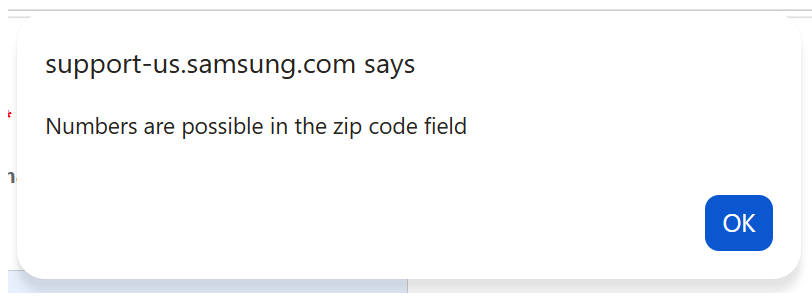
Eventually I corrected the ZIP code and submitted the form. The site responded:
“Your email has been successfully transferred.”
Both messages were understandable after a fashion. Neither communicated clearly.
The washing machine knew exactly what operation would be started.
The web form knew exactly what format it expected.
The systems were functioning correctly.
The communication layer was failing.
This distinction is important because many organizations treat communication as something that happens after the real work is finished. Documentation is written near the end. Help text is added later. Error messages are copied from a library. Confirmation dialogs are an afterthought.
In reality, communication is not a feature sitting on top of the product.
Communication is part of the product.
A control without a clear description is incomplete.
A duration without units is incomplete.
An error message that does not explain the error is incomplete.
The software may function perfectly while the product remains unfinished.
The Tyranny of Easy Fixes
What makes these experiences particularly frustrating is that the solutions are often obvious.
Label the button.
Add the units.
Provide a confirmation dialog.
Describe the function.
Test the documentation against the shipping firmware.
None of these requires advances in artificial intelligence.
None of these requires breakthrough technology.
None requires scientific research.
The fixes are embarrassingly achievable.
That is why they are so irritating.
A difficult problem commands respect. An avoidable problem that persists for years inspires only fatigue.
People like to imagine that experienced engineers spend their days solving deep technical mysteries. Sometimes they do. More often they find themselves staring at a screen thinking:
“This is an easy fix.”
Then they discover that the fix has been obvious for a decade and nobody is responsible for making it.
Why I Sometimes Want to Sell Fish Instead
I occasionally joke that I would rather work as a butcher or a fishmonger.
People assume this means I dislike technology.
The opposite is true.
I like technology enough to care when it is done poorly.
The problem is not that I cannot understand modern products. The problem is that I can see the mistakes.
After a while, every ambiguous icon, every useless error message, every mislabeled button, and every broken workflow starts to feel like a pebble in a shoe, or a smoke detector with a dying battery. The problem is not severe enough to justify immediate action, yet impossible to completely ignore. Not one of them is individually catastrophic. Collectively they become exhausting.
When somebody walks up to a fish counter and asks for two pounds of cod, the transaction is refreshingly honest. There is very little distance between intention and outcome.
Increasingly, the same cannot be said of technology.
Conclusion
I suspect that what many people call enshittification is not primarily the result of greed, incompetence, or malice.
It is the accumulation of thousands of small failures at the boundaries between disciplines.
Hardware engineers designing software.
Software engineers designing interfaces.
Marketing departments designing workflows.
Documentation teams documenting products they did not help create.
Products that technically function but fail to communicate.
The machine knows exactly what it is doing.
The user does not.
The gap between those two facts is where modern frustration lives.
And after forty years of watching organizations repeatedly make the same avoidable mistakes, the dominant emotion is no longer anger.
It is fatigue.
—DG

